China Top Light Wiring Harness Manufacturers Suppliers

China’s light wiring harness sector supports automotive lighting, motorcycles, commercial vehicles, and specialized equipment. It connects lamps, sensors, switches, and control units through compact copper conductors. Small components. Major consequences.

Grand View Research valued the global automotive wiring harness market at approximately USD 52.54 billion in 2022. Its report projects continued growth through 2030, driven by vehicle electrification and rising electronic content. MarketsandMarkets also forecasts expansion, estimating the market could reach about USD 78.5 billion by 2029. These figures provide direction, not certainty. Report definitions and regional coverage differ.

China remains important because its suppliers combine broad component access, flexible production, and competitive tooling capabilities. A capable factory should demonstrate crimp-force monitoring, conductor pull testing, continuity inspection, and traceable batch records. For exterior lighting, sealing quality matters. Water entering a connector can create corrosion, flickering, or complete lamp failure.

Bosch Mobility executive Markus Heyn has said, “Software is becoming the key differentiator in the vehicle.” His observation also affects wiring design. More software requires cleaner signal paths, reliable interfaces, and better electrical architecture.

Selecting China Top Light Wiring Harness Manufacturers Suppliers requires more than comparing prices. Ask for drawings, material specifications, sample reports, and production photographs. Visit the factory when possible. A polished catalog can still hide weak process control. I have seen harnesses that looked perfect until vibration testing exposed loose terminals. That uncomfortable detail matters.

The strongest suppliers understand both manufacturing discipline and practical installation. They deliver a light wiring harness that fits, seals, survives movement, and remains serviceable. Performance should be verified before trust is granted. Industry data helps. Physical evidence decides.
China Top Light Wiring Harness Manufacturers Suppliers

Product Definition: 12V/24V Light Wiring Harnesses and Core Functions

China Top Light Wiring Harness Manufacturers Suppliers

Product Definition: 12V/24V Light Wiring Harnesses and Core Functions

12V and 24V light wiring harnesses are organized electrical assemblies for vehicle, trailer, agricultural, and work equipment lighting. They connect lamps to power sources, switches, control units, and grounding points. A typical harness includes insulated wires, terminals, connectors, protective sleeves, clips, and fuse sections. Wire size must match current demand, circuit length, and expected temperature. A 24V system usually carries less current than a 12V system for the same light output. That difference affects conductor selection and voltage-drop control.

The harness also protects lighting circuits from vibration, moisture, abrasion, and incorrect connections. Sealed connectors help prevent water entry near lamps and exposed frame areas. Flexible coverings reduce rubbing against brackets and metal edges. Clear labels support faster installation and later service work. During production, technicians should check continuity, polarity, terminal retention, insulation condition, and connector fit. Testing matters. A neat harness can still fail if its ground path is weak or its terminals are poorly crimped.

Reliable manufacturers and suppliers should provide drawings, wire specifications, circuit identification, and documented inspection records. Buyers should request samples that match the final routing and connector positions. Trial installation may reveal tight bends, short leads, or clips that loosen under vibration. These problems are easy to miss on a workbench. Better designs use measured routes and practical service allowances, though excessive slack can create new rubbing points. Supplier experience is valuable, but each harness still needs careful verification for its actual 12V or 24V application.

Industry Standards: ISO 6722, IATF 16949, and IP67 Protection Requirements

China Top Light Wiring Harness Manufacturers Suppliers

Industry Standards: ISO 6722, IATF 16949, and IP67 Protection Requirements

China’s top light wiring harness manufacturers and suppliers are often evaluated by process discipline, not catalog size. For vehicle lighting, ISO 6722 guides wire performance under heat, voltage, abrasion, and chemical exposure. A qualified supplier should match conductor size, insulation type, and rated temperature to the actual lamp circuit. That sounds basic. In production, small routing errors can create sharp bends, rubbing points, or loose terminals.

IATF 16949 adds a stronger quality framework for automotive harness production. It requires controlled processes, documented inspections, corrective actions, and traceable materials. During supplier reviews, I look for crimp-force records, pull-test results, dimensional checks, and lot identification. These records show more than a certificate. They reveal whether quality is built into each batch or checked only at the end. A weakness remains common: some specifications are copied without validating real installation conditions.

IP67 protection focuses on the assembled connector and enclosure, not the wire alone. The harness must resist dust ingress and temporary water immersion when seals, backshells, and locks are correctly fitted. Practical testing should include visual inspection, sealing checks, continuity testing, and controlled immersion trials. I would also request temperature-cycle and vibration data. Results can vary after repeated assembly. For this reason, dependable suppliers share test methods, acceptance limits, and revision-controlled drawings before mass production. A careful technical discussion may expose an inconvenient gap, but that gap is safer than a hidden failure in service.

Materials and Specifications: 0.35–6 mm² Wires, XLPE, and 105°C Ratings

China Top Light Wiring Harness Manufacturers Suppliers

Light wiring harnesses commonly use 0.35–6 mm² copper wires for signal, control, and power circuits. The correct size depends on current, circuit length, voltage drop, and installation temperature. A 0.35 mm² wire may suit a sensor circuit, while larger cross-sections support lamps, motors, or auxiliary equipment. XLPE insulation offers strong heat resistance, electrical stability, and durability around tight routing paths.

0.35–6 mm²
Copper Wires

A 105°C rating describes the maximum conductor insulation temperature under specified conditions. It does not mean the harness can safely carry unlimited current. Engineers should review bundle density, ambient heat, terminals, and connector ratings together. In a real harness, a clean crimp matters as much as the wire specification. Loose strands can increase resistance and create local heating.

Dimensional
Checks

Dimensional checks are essential. Verify conductor area, insulation diameter, strip length, bend radius, and terminal retention force. Small deviations can affect assembly quality. A supplier may provide an attractive drawing, yet the production sample still needs testing. This is where sourcing decisions sometimes become imperfect. Ask for material certificates, cross-section reports, temperature tests, and traceable inspection records. Clear labeling also helps workers identify 0.35, 0.5, 1.0, 2.5, and 6 mm² circuits without guessing.

Manufacturing Process: Crimping, Continuity Testing, and 100% Inspection

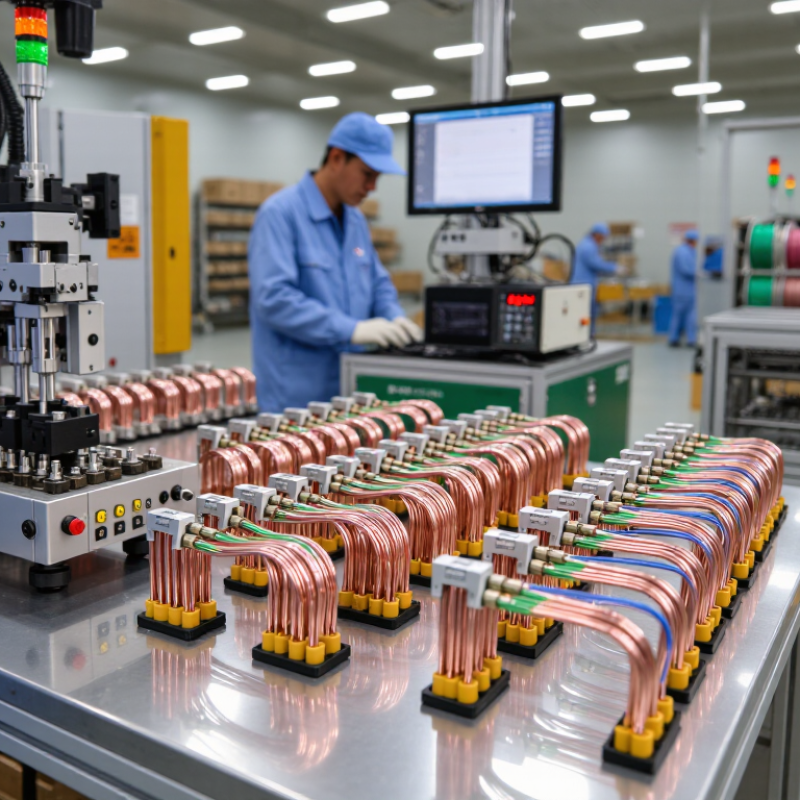
China’s leading light wiring harness suppliers treat crimping as a controlled engineering process, not a routine pressing step. Technicians select terminals and wires according to conductor size, insulation diameter, and application current. Crimp height, pull force, and terminal position are measured during production. The IPC/WHMA-A-620 standard provides widely recognized workmanship criteria for cable and harness assemblies. A 2024 market report from Grand View Research estimated the global automotive wiring harness market at over USD 50 billion, with continued growth through 2030. That growth increases pressure for stable, repeatable production.

Continuity testing follows each wiring stage. Test equipment checks open circuits, short circuits, incorrect pin locations, and unstable resistance. The operator records results against the approved drawing. Small errors can remain invisible.

A 100% inspection system then verifies connector locking, wire color, terminal insertion, labels, and protective coverings. Camera inspection can detect missing clips or poor routing, while manual checks confirm details that software may miss. The International Organization for Standardization reports that process control and documented verification support consistent manufacturing quality under ISO 9001 systems. Still, inspection alone cannot repair weak crimping. One overlooked calibration issue can affect many assemblies. Experienced Chinese suppliers therefore combine first-article approval, hourly sampling, full continuity testing, and traceable inspection records. The process is strong, but never perfect. That limitation deserves honest review.

China Top Light Wiring Harness Manufacturers Suppliers - Manufacturing Process: Crimping, Continuity Testing, and 100% Inspection

Manufacturing Stage Key Process Parameters Typical Equipment or Method Quality Data or Measurement Acceptance Criteria Inspection Coverage
Incoming Material Verification Conductor size, insulation type, terminal specification, connector cavity and color identification Calipers, micrometers, material certificates, visual inspection and barcode traceability Wire cross-sectional area, insulation diameter, terminal plating and connector part compatibility Materials must match the approved drawing, bill of materials and applicable wire specifications 100% identity check
Wire Cutting and Stripping Cut length tolerance typically controlled to approximately ±1–2 mm; strip length based on terminal design Automatic wire cutting and stripping equipment with calibrated length settings Finished wire length, strip length, exposed conductor strands and insulation damage No severed conductor strands, no insulation cuts, and exposed conductor length within drawing tolerance 100% visual check
Terminal Crimping Crimp height, crimp width, bellmouth, conductor brush and insulation support Applicator-based crimping press with tooling adjustment and crimp-force monitoring Crimp height measured with a micrometer; pull force verified by destructive sampling Crimp geometry and pull force must meet the terminal manufacturer’s approved specification 100% process control
Crimp Pull-Force Verification Test frequency defined by the control plan; sample size increases after tooling or material changes Calibrated tensile pull tester Maximum separation force between the crimped terminal and conductor Measured force must be equal to or greater than the approved specification for the wire and terminal combination Sampling inspection
Connector and Component Assembly Terminal insertion direction, locking lance engagement, cavity position and secondary lock placement Assembly fixtures, insertion-force checks and connector position templates Terminal seating, connector polarity, cavity sequence, lock engagement and component orientation All terminals fully seated; no back-out, damaged locks, incorrect cavity positions or reversed components 100% visual check
Branching, Taping and Protection Branch location, tape overlap, protective sleeve position and bend radius Dedicated assembly boards, routing fixtures and measured reference points Overall harness length, branch dimensions, tape coverage and protective material placement Routing must follow the approved layout; no exposed conductor, loose wrapping or excessive bending 100% visual check
Continuity Testing Open-circuit, short-circuit, miswire and incorrect pin-to-pin connection detection Programmable cable and harness tester with a fixture matched to the connector layout Electrical resistance, connection map and fault code for each tested circuit Every intended circuit must pass; no open circuit, short circuit, cross-wire or incorrect connection 100% electrical test
Insulation and Dielectric Testing Applied voltage, test duration and insulation resistance set according to the product specification Electrical safety tester with controlled ramping and automatic discharge Insulation resistance, dielectric withstand result and leakage-current reading where applicable Pass limits must comply with the approved customer specification and applicable safety requirements As specified
Dimensional and Appearance Inspection Overall length, connector orientation, branch position, terminal condition, labeling and cleanliness Inspection board, go/no-go gauges, measuring tools and controlled lighting Dimensional results, visual defect classification and identification-mark accuracy No missing parts, damaged insulation, bent terminals, exposed strands, contamination or incorrect labels 100% final inspection
Final Traceability and Packing Production date, work order, inspection status, quantity and packaging configuration Barcode or batch records, packing checklist and protective packaging materials Lot number, test result, operator or station record and packed quantity Only products with completed process records and passed final inspection may be released 100% release check

Note: Actual wire sizes, crimp dimensions, pull-force values, electrical limits and inspection frequencies are determined by the approved engineering drawing, terminal specifications, customer requirements and applicable industry standards.

Supplier Evaluation: MOQ, Lead Time, PPAP, Traceability, and Cost Metrics

For China’s light wiring harness suppliers, MOQ should be tested against actual vehicle demand, not quoted alone. A 500-piece MOQ may reduce unit price, yet it can increase inventory and aging risk. Request MOQ by harness variant, connector type, and cable color. Lead time should show sampling, tooling, PPAP, and mass production separately. McKinsey Global Institute reports that major supply disruptions lasting one month or longer occur about every 3.7 years. Build a second-source plan early.

Ask for PPAP evidence before approving production. The file should include drawings, material certificates, dimensional results, control plans, process flow, and capability studies. AIAG’s PPAP guidance supports documented evidence that production can repeatedly meet requirements. Do not accept “sample passed” as full approval. It is incomplete. For traceability, require lot codes on terminals, seals, wires, and finished harness labels. A practical record should connect each harness to operators, machines, test results, and shipment dates. Resilinc’s 2024 EventWatchAI report recorded more than 3,400 disruptive events in 2023, showing why searchable records matter.

Cost evaluation needs more than the piece price. Compare copper content, tooling amortization, inspection labor, packaging, freight, scrap, rework, and warranty exposure. Calculate landed cost per accepted harness. A supplier with a higher quote may perform better if first-pass yield is stronger. Still, capability numbers need verification through recent production data. Ask for three months of yield records, not a polished single-day sample. Mistakes happen. The review should expose them early.