What is a Smart Potentiometer and How Does It Work?
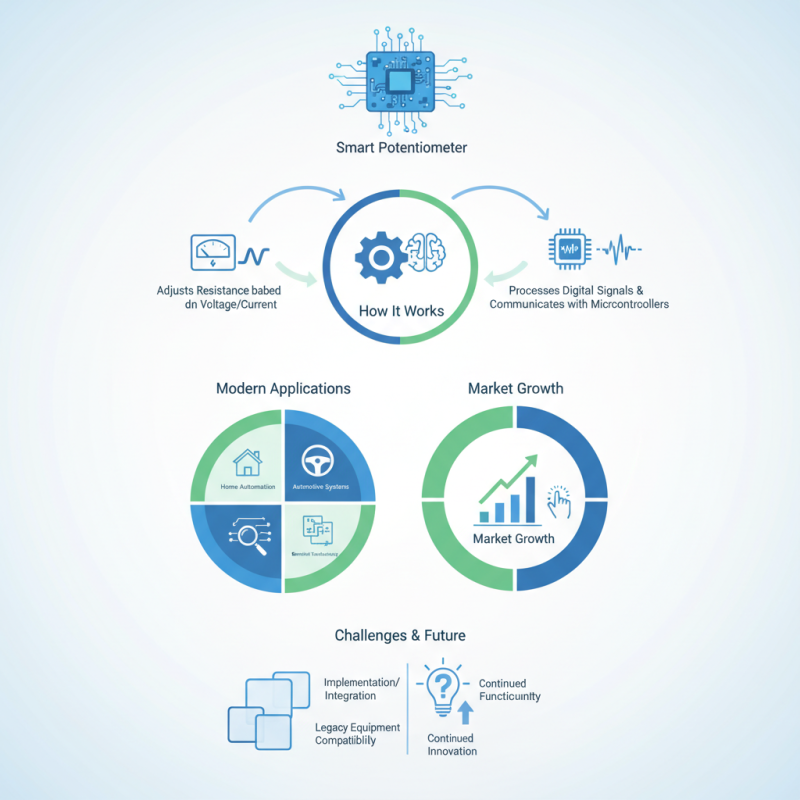
The Smart Potentiometer has revolutionized traditional circuitry. In modern applications, it plays a crucial role in sensor technology and adjustable devices. According to a report by Grand View Research, the global potentiometer market is expected to grow at a CAGR of 6.4% from 2021 to 2028. This growth highlights the increasing demand for more precise and versatile electronics.
These devices adjust resistance intelligently in response to voltage or current changes. Unlike conventional potentiometers, Smart Potentiometers can process digital signals and communicate with microcontrollers. They enhance user experience in various fields, from home automation to automotive systems. Data from MarketsandMarkets indicates the smart sensor market, which includes Smart Potentiometers, may reach USD 64 billion by 2026, reflecting their importance.
Despite these advancements, challenges remain in implementation and integration within existing systems. Designers must consider compatibility and limitations of legacy equipment. The learning curve for users can also pose barriers. Nonetheless, with continued innovation, Smart Potentiometers promise to further enhance functionality and reliability in electronic systems.
Understanding the Basics of Smart Potentiometers
Smart potentiometers are key components in modern electronics. They offer precise control over voltage and current, making them vital for various applications. These devices can be adjusted digitally, replacing traditional analog potentiometers. This advancement allows for greater flexibility in design and functionality.
Understanding smart potentiometers begins with their basic structure. They contain sensors that detect resistance changes. This data is converted to a digital signal. Users can adjust settings through a microcontroller interface, enabling real-time control. Such capabilities make them ideal for applications in audio systems and sensor technology. However, the complexity of their design can lead to challenges.
Developers must ensure proper calibration and coding. Unforeseen errors may arise, affecting performance. A need for constant adjustment may also occur. This highlights the importance of testing and validation in real-world scenarios. While smart potentiometers streamline processes, their integration requires careful planning and execution.
Key Components of a Smart Potentiometer
Smart potentiometers have gained traction in various industries due to their advanced capabilities. The key components of a smart potentiometer include sensors, microcontrollers, and communication interfaces. These elements work together to enhance functionality far beyond traditional potentiometers. According to a report by MarketsandMarkets, the global smart potentiometer market is projected to grow significantly, reaching USD 3.1 billion by 2025.
The sensors form the backbone of a smart potentiometer, detecting changes in resistance and converting them into digital signals. Microcontrollers process this data, enabling precision control in applications such as audio equipment, lighting systems, and robotics. Communication interfaces, often using protocols like I2C or SPI, facilitate interaction with other digital components, enhancing system integration. A report by Research and Markets highlighted that 40% of smart potentiometers are utilized in home automation, underscoring their versatility.
Despite these advancements, challenges remain. The complexity of integration into existing systems can present hurdles for developers. Additionally, as with any electronic device, reliability can vary based on environmental conditions. Understanding these potential drawbacks is crucial for engineers aiming to implement smart potentiometers effectively in their projects. Overall, examining these key components reveals both the promise and the barriers that continue to shape the evolution of smart potentiometers.
How Smart Potentiometers Function and Operate
Smart potentiometers represent a significant advancement in electronic control systems. They are versatile components used in various applications, including audio devices and industrial controls. Unlike traditional potentiometers, smart versions incorporate digital interfaces for enhanced functionality. This integration allows them to communicate with microcontrollers or computers, providing real-time adjustments and data processing.
The operation of smart potentiometers relies on sensing technology and precise motor control. They measure resistance changes to produce accurate voltage outputs. Advanced algorithms process these signals, enabling fine-tuning of parameters like volume or speed. The digital aspect allows for programmable settings, which can simplify complex tasks. However, some users might find the initial setup challenging. The learning curve can be steep, making it essential to have proper guidelines and support.
Moreover, smart potentiometers are not immune to limitations. Potential issues include sensitivity to environmental conditions and the risk of software glitches. Regular maintenance and updates are crucial to ensure reliability. Users should remain aware of these factors to maximize the benefits of their smart potentiometers.
Applications and Benefits of Smart Potentiometers
Smart potentiometers are revolutionizing various fields with their remarkable applications and benefits. These devices provide precise control over electrical signals, making them integral in many modern technologies. For instance, in audio equipment, smart potentiometers adjust volume with great accuracy. Users benefit from smoother control and increased reliability compared to traditional options.
In industrial settings, smart potentiometers enhance automation processes. They offer superior interface solutions for machinery, improving efficiency. They can be integrated into control systems, allowing real-time monitoring. This adaptability helps in reducing costs and downtime. Furthermore, industries often struggle with integrating new technologies. Smart potentiometers may require adjustments to existing systems but can lead to long-term gains.
In consumer electronics, smart potentiometers improve user experiences. They allow for self-calibration, adapting to user preferences. However, their complexity can be a barrier for some. Users might find the initial setup daunting. This reflects a need for better user education. Tech advancements continue to push the boundaries of what smart potentiometers can achieve, making them a critical study area for future innovations.
Smart Potentiometer Applications and Benefits
Comparing Smart Potentiometers with Traditional Potentiometers
Smart potentiometers are revolutionizing control systems, offering several advantages over traditional types. Unlike standard potentiometers that rely on mechanical movement, smart potentiometers utilize digital technology. This makes them more precise and reliable in various applications, from audio equipment to industrial machines. The digital signal processing in smart potentiometers ensures higher accuracy and quicker response times.
Another significant difference lies in their adaptability. Traditional potentiometers often have fixed resistance ratios, which limit their functionality. In contrast, smart potentiometers can be programmed for specific tasks. This flexibility enables easy integration into complex systems, allowing for seamless adjustments and control. However, the complexity of smart designs can lead to potential issues if not carefully calibrated.
Despite these advancements, some users may find smart potentiometers less intuitive. The learning curve can be steep, especially for those familiar with analog systems. Additionally, the reliance on electronics introduces failure points. A malfunction in the embedded components can disrupt the entire system. Careful consideration and testing are essential to harness their full potential.
